
A concussion can change everything for weeks — or months. The headaches fade, then come back. Thinking feels slow. Sleep is broken. And for athletes, a sports injury that should have healed in days can drag on far longer than expected.
If you live in Muswell Hill or North London and you are looking into hyperbaric oxygen therapy — HBOT — for concussion or sports recovery, this guide explains what it is, what the evidence actually says, what a session costs and what to expect at Just Breathe Hyperbarics.
No miracle claims. Just honest, practical information — and a clear note on when to see a doctor first.
First, the Important Part: See a Doctor About a Concussion
A concussion is a brain injury, and it should always be checked by a doctor first — especially if it just happened. Go to A&E or call 111 urgently if you notice worsening headache, repeated vomiting, slurred speech, weakness, seizures or you cannot be woken up.
HBOT is not emergency treatment and it is not a replacement for medical care. Anyone thinking about HBOT after a concussion should talk to their GP or specialist first, and only consider it once the urgent medical checks are done. The same applies after a serious sports injury: get the injury properly diagnosed before booking any therapy.
What Is HBOT?
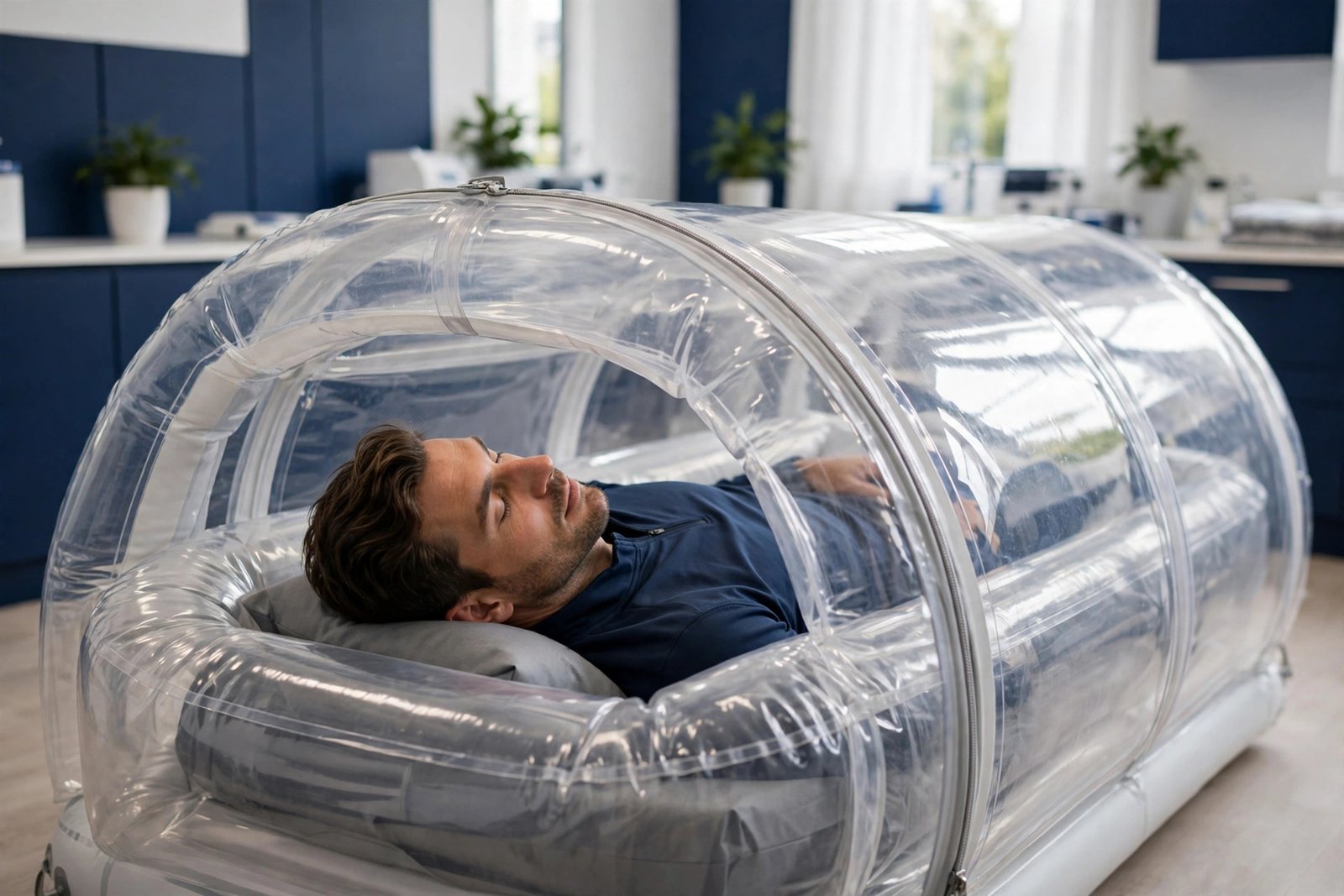
Hyperbaric oxygen therapy means breathing 98% oxygen inside a pressurised chamber. At Just Breathe in Muswell Hill, the chamber is a soft-shell chamber at 1.5 ATA — about one and a half times normal air pressure. You lie down inside, relax, and breathe normally for the session, usually 60 minutes.
Normal air is about 21% oxygen. Inside the chamber, the higher pressure helps your blood carry more oxygen to your tissues. The idea behind HBOT for recovery is simple: injured tissue — whether brain tissue after a concussion or muscle after hard training — may heal better when it gets more oxygen.
That is the idea. It is not a guarantee, and it is not the same as a cure.
Read our full guide to hyperbaric chambers in London for the full picture on chamber types and costs.
HBOT for Concussion: What Does the Evidence Say?
This is where honesty matters. Research into HBOT for concussion and mild traumatic brain injury is still early. Some small studies have reported improvements in symptoms such as headaches, fatigue and “brain fog” after a course of HBOT sessions. Other researchers point out that the studies so far are small, and that more large, high-quality trials are needed before anyone can say for certain how well it works, or for whom.
What that means in practice:
- HBOT is not a proven treatment for concussion. It is something some people try alongside proper medical care, not instead of it.
- Results vary a lot from person to person. Some people feel a difference; others do not.
- A course usually means several sessions over a few weeks, not a single visit. How many sessions makes sense is something to discuss with the clinic — and your doctor.
- If a clinic promises to “cure” your concussion, be cautious. A good clinic will be honest about what is and is not known.
For Harry, this is personal — his own experience of recovering from concussion is part of why he opened Just Breathe in Muswell Hill.
Related reading: our guide to HBOT for Long Covid in North London.
HBOT for Sports Recovery: What Athletes Use It For
Athletes in North London use HBOT for a different reason: recovery between training sessions and after injury. Hard training leaves muscles sore and tired, and the idea is the same — more oxygen reaching the muscles may support the body’s natural repair processes.
People commonly ask about HBOT for:
- Muscle soreness after heavy training — getting back to training sooner.
- Soft-tissue injuries — sprains, strains and bruises that are slow to settle.
- Recovery after matches and long runs — marathon and endurance athletes in particular.
- General fatigue — when training load is high and sleep alone is not enough.
Again, the honest version: HBOT is a recovery support, not a shortcut. It does not replace rest, sleep, good food, physiotherapy or proper coaching. What athletes often value most is simple: an hour of lying down and breathing, with no phone and no noise, after a hard week of training.
What Does a Session Feel Like?
If you have never tried HBOT, the first session is the one people worry about most — and it is usually much simpler than they expect.
You lie down in the chamber, which at Just Breathe is a soft-shell pod rather than a metal tube. The pressure rises slowly, and your ears may pop, a bit like taking off in a plane. Swallowing or yawning usually clears it. Then you just lie there and breathe 98% oxygen for about 60 minutes. Most people read, listen to music or simply rest.
Tell the clinic beforehand if you have ear problems, a cold or sinus trouble, claustrophobia or any lung condition — and always mention if you are pregnant. These are the things a good clinic will ask about before your first session, because safety comes first.
How Much Does HBOT Cost in Muswell Hill?
Just Breathe’s prices (checked November 2026):
- Single 60-minute session — £80
- Intro offer: 3 × 60-minute sessions — £190 (about £63 per session)
- 5 × 60-minute sessions — £325
- 10 × 60-minute sessions — £630
- 20 × 60-minute sessions — £1,200
- Single 90-minute session — £110
At £80, a single 60-minute session at Just Breathe is the cheapest single session found among London HBOT clinics in our November 2026 comparison — the next cheapest single session was £100 in Soho. Packages bring the per-session price down further, which matters when recovery means several sessions rather than one.
For the full breakdown, see our guide to how much HBOT costs in London and the pricing page.
Why Muswell Hill?
HBOT usually means several sessions over a few weeks, so location matters. Just Breathe is at 181 Priory Road, Muswell Hill, London N8 8NB — easy to reach from Crouch End, Finchley, Highgate and Wood Green, without a trip into central London after every session. Call 07748 086495 to ask about availability.
Quick Answers
How many sessions will I need?
It depends on the person and the problem. Some people try a few sessions and decide from there; others book a package. There is no honest one-size-fits-all number — ask the clinic, and your doctor, what makes sense for you.
Is HBOT safe?
For most healthy adults it is generally well tolerated, but it is not for everyone. Ear problems, certain lung conditions, claustrophobia and pregnancy are all reasons to check first. Always tell the clinic your full medical history.
Can I do HBOT instead of seeing a doctor?
No. For a concussion or a serious injury, see a doctor first. HBOT comes after the medical checks, never instead of them.
Do I need to do anything before a session?
Wear comfortable clothes, avoid heavy perfumes or lotions and arrive a few minutes early so the session can start on time. The clinic will explain the rest.
The Bottom Line
HBOT for concussion and sports recovery is a promising idea with early, limited evidence — not a proven cure. For some people in Muswell Hill and North London, it is a practical way to support recovery: local, affordable at £80 a session and an hour of real rest in a busy week.
If you are recovering from a concussion, see your doctor first. If you are an athlete looking for an edge in recovery, ask the clinic what a realistic plan looks like — and be wary of anyone who promises more than the evidence supports.
See all the conditions we help with.
Medical disclaimer: This article is general information only and is not medical advice. HBOT is not a treatment for concussion or any medical condition. Always consult your GP or specialist before starting HBOT, especially after a head injury. If you have concussion symptoms, seek medical attention first.
Medical note: Hyperbaric Oxygen Therapy at Just Breathe Hyperbarics (1.5 ATA soft-shell chamber) is provided as a supportive wellness and recovery therapy. Always consult your licensed healthcare provider to determine whether HBOT is appropriate for you.